
The Case for Limits: Esther Dyson and Unity Stoakes Discuss Staying Human in an Age of Abundance and Superintelligence
This is a conversation about limits – why they matter, what they protect, and how they might be the missing counterweight in an era of runaway scale. What follows is an edited Q&A with Esther Dyson.
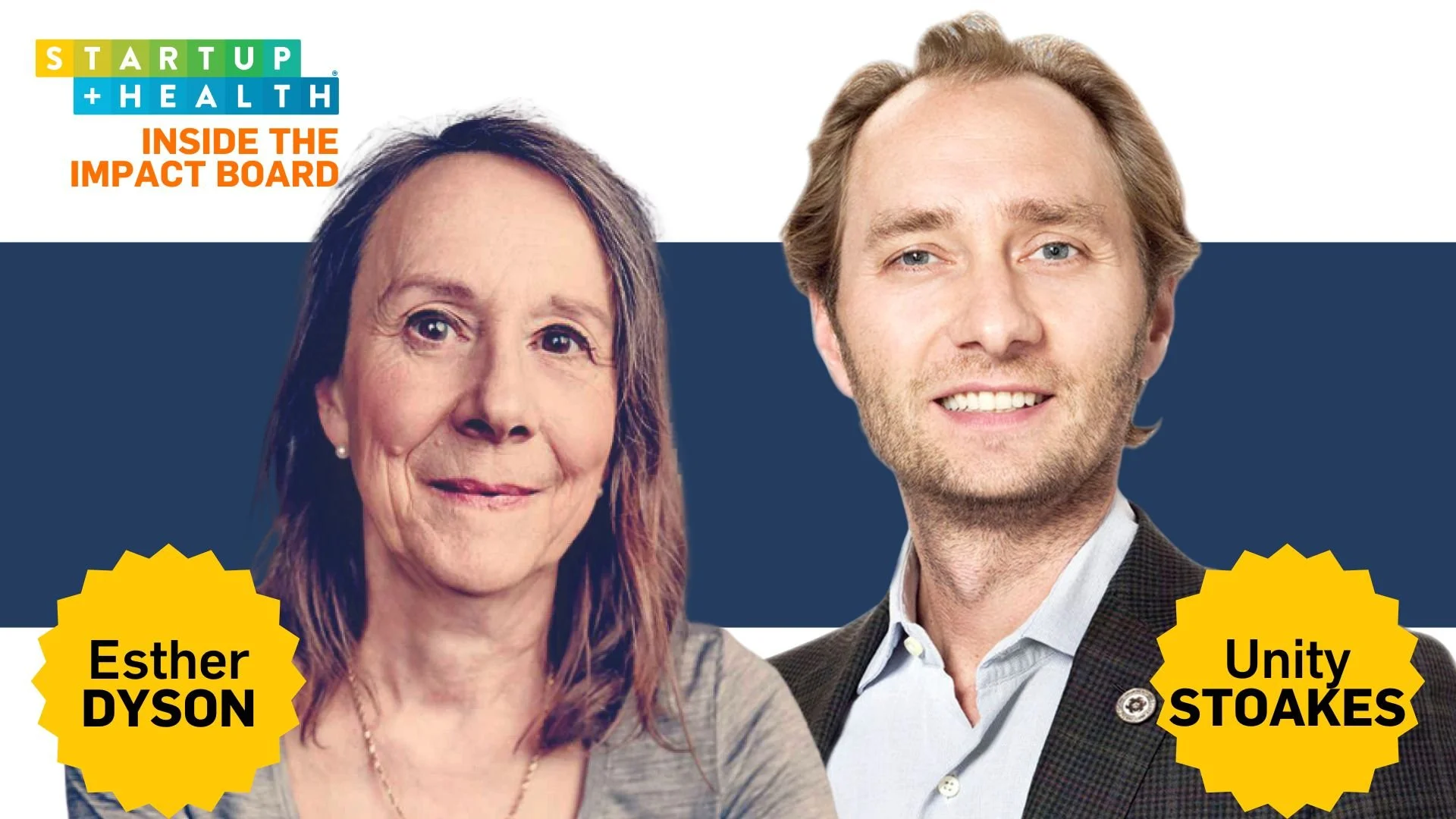
A note from Unity Stoakes
I’ve been fortunate to know Esther Dyson for 30 years – long enough to experience firsthand how rare her generosity, clarity, and deep wisdom truly are.
Esther was StartUp Health’s first angel investor – years before we were even called StartUp Health – and she has shown up ever since as one of our longest-serving Impact Board members on our journey to achieve health moonshots. She’s also one of my most trusted mentors and friends. I’m deeply grateful that, over the years, she has gifted our community of Health Transformers the most precious resource of all: her time.
Esther has a way of cutting through noise without losing nuance. She asks the kinds of questions that stay with you – sometimes for years.
Earlier this month, I had the good fortune to spend an afternoon with Esther in downtown Oakland, overlooking the port at sunset – ships moving in and out, constant motion, a quiet reminder that everything has a season. It was the perfect backdrop for a conversation about term limits – not just in politics or leadership, but in life: the boundaries that give meaning to our choices, and the discipline required to honor limits in a world addicted to ‘more.’
We talk about her upcoming book on term limits, the seductions and dangers of abundance, the AI bubble debate (and what bubbles really mean), and what must remain distinctly human as superintelligent tools reshape culture – including healthcare. Esther doesn’t offer ten tidy takeaways. She offers something better: hard-won wisdom, generously shared, and an invitation to ask better questions.
Why write a book about term limits?
Unity Stoakes:
You are writing a new book about term limits. What does that even mean, and why did you decide to write it?
Esther Dyson:
“Term limits” is basically the notion that most things should both begin and end; endlessness is not a good goal. I started to think about this two summers ago, when Joe Biden refused to resign. Meanwhile, Jimmy Carter died and people mourned instead of celebrating his life. And my 10-year Wellville project was coming to its planned end, but more people than I expected were slightly awkwardly asking why, as if I had canceled it for cause. The notion of term limits was everywhere – and so I took it as a core concept that people often misunderstand.
I did not start this book because I felt I knew everything and wanted to teach people. I started it because I had this concept of term limits and a lot of questions. The basic premise is simple: Human beings are finite. We are born, we live, we die. I think we need to become comfortable with that and see the benefits.
We come and go, but the universe continues. History continues. Ideally, we leave something behind. One of the examples in the book is an old Russian tradition called “sitting for the road.” Before a journey, you sit and reflect: What did I leave behind on purpose to thank my hosts? What did I leave by mistake? What lies ahead, and am I prepared not to come back?
Our lives are like that. We need to be ready to leave, not pretend that if something is good, we must have an infinite amount of it, or if something is bad, we must shun it altogether. Enough really can be enough.
What do you mean by “enough is enough”?
Unity:
You mentioned a sign at the Lone Star Cafe (in NYC) that said, “Too much ain’t enough.” How does that idea show up in your book?
Esther:
That sign has been stuck in my head for years. To me, the point is: Enough is enough.
Nothing is so terrible that you should avoid it completely, and fail to acknowledge it. Nothing is so wonderful that you need an infinite amount of it. Yet we live in an increasingly transactional world where everything feels like a volume game. More money, more data, more followers, more valuation.
We are losing our sense of value and replacing it with price and quantity. Human beings have value outside those metrics, but we keep building systems that treat us like quantifiable sources of attention and data to be optimized.
Are you writing philosophy, memoir, or a book about the future?
Unity:
Is this a book of philosophy, about the world we are in, or something else?
Esther:
It is all of that, but still pretty short. There is some philosophy, some evolution, and a lot about what AI is and is not. Because I have spent so long in tech and around the world, I use a lot of personal examples and stories about people I know. Some I name; some I do not.
The book is not about telling people things they never heard before. It is about helping them see things they already know in a different light. How am I missing out on what actually gives me joy because I am trying to optimize everything?
There are chapters on money and power and how they interact, on philanthropy, on AI and business structures. I do not touch everything. I do not talk much about religion or formal education, for example. Instead, I hope other people will take the core idea and apply it in their own domains.
How does abundance change our behavior?
Unity:
You have said humans evolved to want more. How is that colliding with this new era of abundance?
Esther:
We evolved in a world of scarcity. You could not get too much food or safety or shelter, because everything was limited and hard to obtain. Always wanting more made sense.
Now we live in an era of abundance, although it’s very unevenly distributed. Many of the people who have the most are the ones who want more power, more attention, more everything. They end up with ultra processed food, ultra processed information, and even ultra processed humans, in a sense.
Our fitness function has been hijacked. It used to be: Get enough to survive. Now it is: Get as much as possible of everything. That is not actually good for us in the long run.
How do term limits relate to AI and superintelligence?
Unity:
We are entering an age of AI and what some call superintelligence. Does that make term limits more important?
Esther:
Yes, partly because term limits are now being questioned. Historically, people understood that they would die. Maybe they believed they would live on in another form, but they did not think literal immortality was an option.
Now some people see immortality as a real possibility for a small group. Pair that with enormous inequality and you get something very unstable and disturbing.
AI also changes the time equation. AI can move infinitely fast. Humans cannot. If you can scale computation and decisions almost instantly, but you cannot scale wisdom or emotional processing, you get a dangerous imbalance.
So term limits are not just about death or retirement. They are about acknowledging that even in an age of abundance and infinite compute, human lives, attention, and bodies are finite, and that is not a bug. It is a feature. It helps us set valid priorities… not to quantify, but to choose, to manage trade-offs
What worries you about the current AI “bubble”?
Unity:
There is a frenzy around AI, valuations, and new tools. Does this feel like a bubble to you?
Esther:
Yes, it is a bubble. A bubble does not mean the thing is fake or that it will disappear. It means there is too much air in the system. Prices, expectations, and stories expand far beyond reality.
Eventually, the air comes out and things return closer to their real value. What worries me is that this bubble is tied to political extremism, information wars, and real-world harm. Health care inequality has been killing people for a long time already, but these tools can make those inequalities worse, faster, and more visible – even as the causes stay hidden.
At the same time, there is incredible potential. Billions of people have access to a device that can act like a private advisor, including for health advice, where before they had nothing. That is powerful and hopeful. The question is whether we design the systems around these tools to serve humans, or whether we let predatory business models dictate the fitness function. In the end, AI can act more like a parasite than a predator, keeping you alive to suck on.
Who do you hope reads this book?
Unity:
Who is this book for? Founders, investors, educators, everyone?
Esther:
Everyone who is interested in asking questions rather than collecting ten quick tips for living in the age of AI. I am specifically trying to make sure the book tour goes beyond the usual intellectual gathering places and reaches the Wellville communities, young people, healthcare workforces.
Different readers will find different entry points. There is a chapter on philanthropy that I hope donors and nonprofit leaders read. People in education may see new ways to apply the idea of term limits and fitness functions in their work. Founders and investors may see themselves in the sections on power, valuation, and bubbles.
Honestly, most of the real action will probably be outside the book: Substack posts, blog posts, podcasts, conversations like this one. The book is short. It is not designed to pour knowledge into your head. Real learning is more like decorating a Christmas tree. [This conversation took place in early December.] You take pieces of knowledge and arrange them into a pattern that matters to you.
What about your own “term limits” and next chapter?
Unity:
You have been remarkably consistent for decades as someone who asks questions and challenges assumptions. How are you thinking about your own next chapter?
Esther:
Term limits are not just endings. They are transitions. The question is not, “How do I perfect this forever?” It is “When is it time to move on, so I can make space for what matters next? What am I passing along?”
I recently wrapped up a ten-year effort with Wellville. We originally thought it would be five years and realized we needed ten. Knowing there would be an end forced us to set priorities, not infinite tasks.
After this book, I want to write another one that is more explicitly autobiographical and fun, called Present Without Leave. It will be about adventures: training as a cosmonaut in Russia, visiting an orphanage in Azerbaijan, sneaking into swimming pools, wandering through places I was not technically supposed to be in. (I have a collection of “you should not be here” signs.) Mostly it will be about curiosity. The world is an amazing place to explore, and I want to share what I have found so others feel invited to explore too. That’s what I want to pass along!
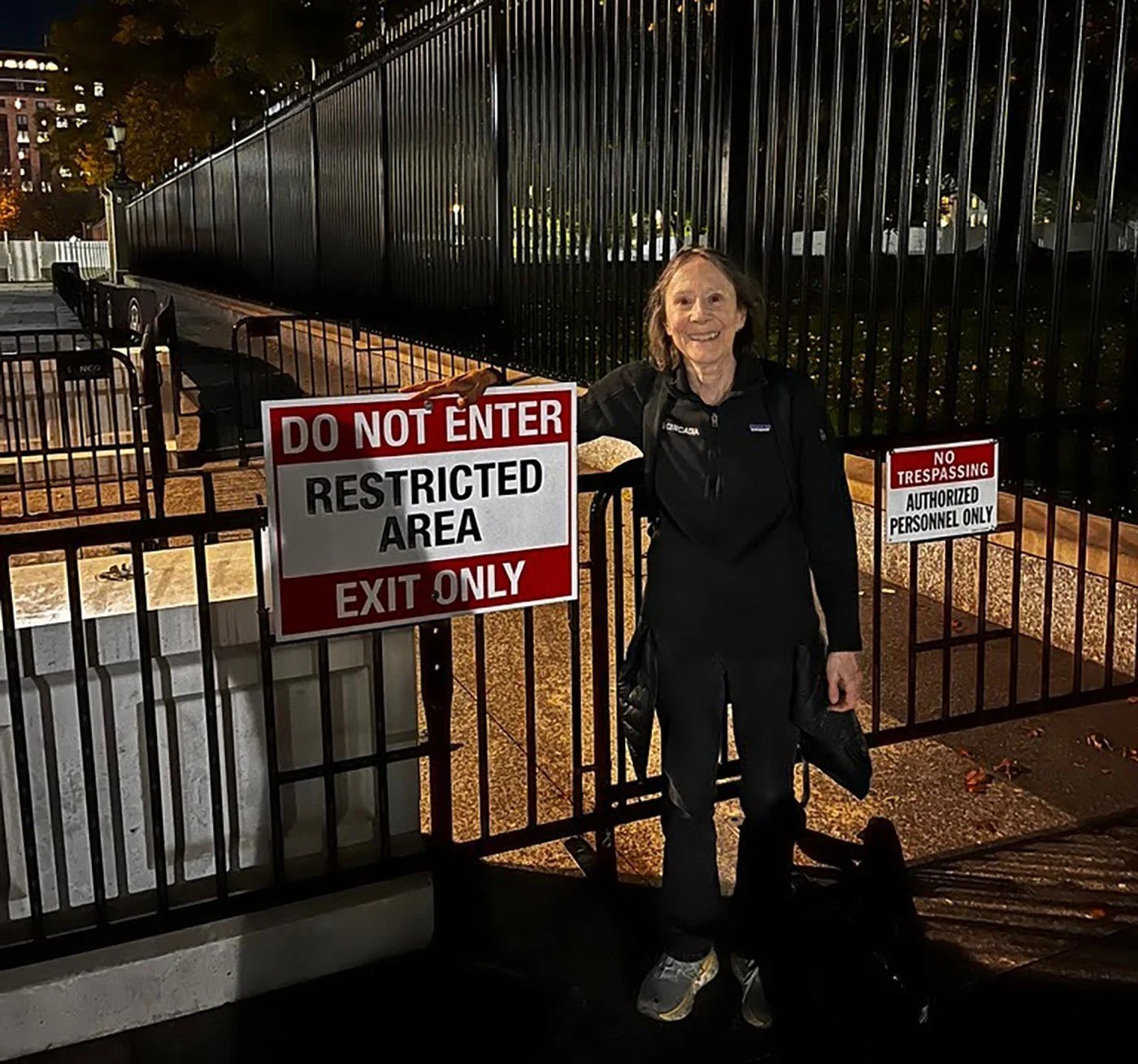
Esther outside what used to be the East Wing of the White House (November 2025).
You talk a lot about curiosity. Has that always been your compass?
Unity:
You seem to structure your life around curiosity and new experiences. Has that been true since childhood?
Esther:
Pretty much. My parents were both scientists, so asking questions was normal. When I was thirteen, I persuaded my father to send me to London to live with friends of his. Later, when I was in college, I took time off and went to Morocco to live with my boyfriend who was in the Peace Corps. I was not supposed to be there, so when the Peace Corps supervisors came to visit, I hid under the bed.
I like stretching boundaries, but I am also very aware of my privilege. I can walk into places, ask questions, and usually be welcomed or at least tolerated. That is not true for everyone. Recognizing that does not cancel the privilege, but it does obligate me to use it more thoughtfully.
I do not like ultra-processed experiences. I would rather see the dress rehearsal than the polished opening night. I like real life, with its awkwardness and unpredictability.
You have strong views on philanthropy and “ultra-processed” goodness. Why?
Unity:
You draw an analogy between ultra-processed food and ultra-processed money or experiences. What do you mean?
Esther:
Ultra-processed food takes something basic and turns it into something that hijacks your appetite and your metabolism. You get calories, but not real nourishment, and often real harm.
We have ultra-processed content that hijacks our attention. And we have ultra-processed money and generosity, where the social performance of giving matters more than the human connection.
For example, I have been pitched many times to be “woman of the year” or some such “honor” at some gala I have never heard of, implicitly in exchange for a donation and a table of wealthy donor-friends. That kind of thing corrodes your moral metabolism. You start giving for the spotlight, not for the beneficiaries
In contrast, I remember a story from N. R. Narayana Murthy, one of the founders of Infosys. He talked about his childhood village, where his family was the richest in the area. When hungry people came to the house, they did not hand food out the back door. They invited them to sit at the table and eat with the family. That is not charity at a distance. That is sharing, with mutual recognition. It changes both sides for the better.
What stays human in a high-tech health future?
Unity:
You have spent a decade with Wellville and a lifetime around health and tech. What do you think AI should and should not replace in healthcare?
Esther:
In one sense, AI should replace a good deal of what doctors currently do, because many doctors have become nodes in a referral machine. They diagnose, then pass you on, and the system pays them for that. AI can often do the diagnostic and informational part better and faster.
What AI cannot and should not replace are the nurses, doulas, community health workers, caregivers, and teachers who build relationships and support behavior change. Two of the most powerful moments I was “present” at over the course of Wellville were meetings between middleaged men and their kindergarten teachers. These grown men became shy children again, and you could see how seen and valued they felt, while the teachers knew that their loving discipline had made a difference. That kind of relationship is irreplaceable.
We should be using AI to free up humans to do more of that kind of work, not to pretend to replace it.
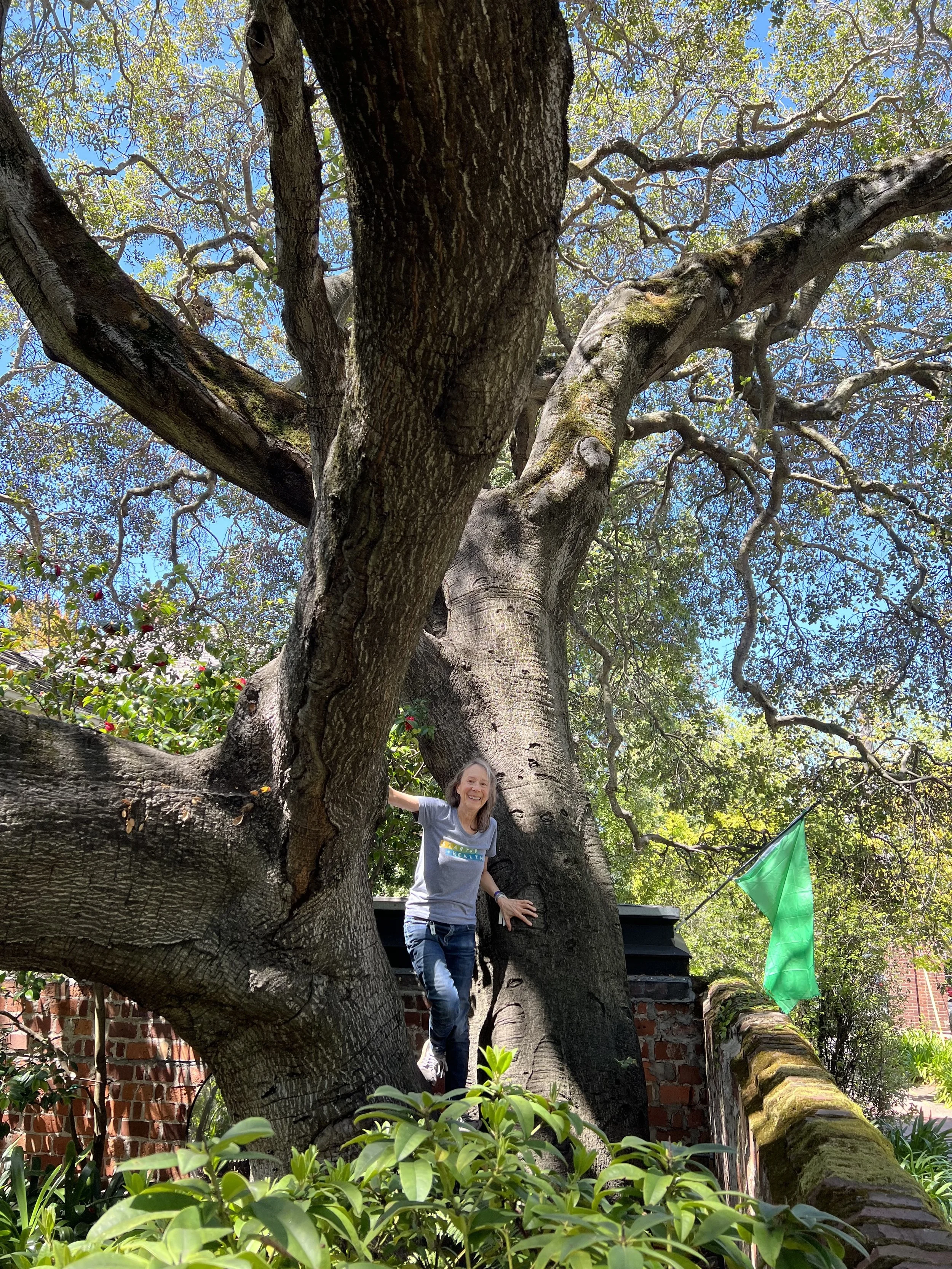
Esther Dyson in Unity Stoakes’ beloved “Giving Tree” on Derby Street in Berkeley, CA.
Are you an optimist?
Unity:
You say you are not a doomer. Are you an optimist?
Esther:
I call myself a cynical idealist. I do not want to predict the future. I want to influence it.
If we – and defining “we” is itself a challenge – can behave more sensibly, then things can get much better. If we keep operating under the fitness functions of predatory business models that turn us into addicts and commodities, then things will get worse.
So I am conditionally optimistic. My hope lies in people seeing more clearly how they are being shaped and manipulated, and choosing different goals.
What advice do you have for young people building their education and careers?
Unity:
How should young people think about education and their work in this moment? What should they learn or prioritize?
Esther:
First, learn how to learn. Stay curious. Do things that terrify you a little. And in the other direction, if you have that luxury, never do anything that you wouldn’t do for free….. But try to get paid if you can!
Second, cultivate what I call theory of business mind. We all grow up with theory of mind. As babies, we feel what our parents feel; then we realize that our actions affect their emotions. We learn that other people have minds and motivations.
What we do not learn as naturally is theory of business mind. Why is this company being so nice to me? Why does this food taste so good, even though I know I will feel sick tomorrow? Why is this app so hard to put down?
You need to understand not just your own motivations, but the business models around you. Some people really care about you. Others care about your time, your data, or your money, because that is how their world is structured.
Finally, two pieces of career advice I live by:
Always make new mistakes. Do not keep repeating the old ones.
Try not to do anything you would not do for free (but try to get paid!). In other words, love what you do enough that the work itself matters, then build a life where you are compensated for it.
What do you hope people actually do after reading your work?
Unity:
When people read this book or your essays, what is the change you want to see?
Esther:
I want people to ask better questions. Not just “How do I get more?” but “What am I optimizing for, and is that actually good for me and for others? What will be the result long term?”
I hope people will look at their industries, their communities, and their own behavior and ask: How do term limits apply here? Where are my boundaries? Where should I stop, hand off, or let go? How am I being shaped by fitness functions that are not aligned with my values?
This really is a transition moment. In some sense, it is a term limit moment for the world we have known. We can respond blindly and let the systems around us define our value, or we can choose different priorities.
If my book and the conversations around it help even a few people choose differently, that will feel like a good use of my finite time.
Watch on StartUp Health TV
Listen on StartUp Health NOW
Join Us at Apollo House During JPM Week
Apollo House is StartUp Health’s summit for visionaries who are building the future of health in the age of superintelligence. During JPM Week in SF, we will bring together founders, investors, researchers, policymakers, and partners who share a commitment to solving the world’s biggest health challenges.
If you believe in the power of collaboration, community, and exponential innovation, we invite you to be part of this important conversation and help accelerate progress for humanity.
Join StartUp Health
An exclusive global community for the bold decision makers, thought leaders, funders, and innovators transforming the future of health
Network Plans for Everyone in the Ecosystem: If you're a decision maker, thought leader, funder, or industry stakeholder – this is where the global health ecosystem comes together to learn from experts, share insights, build relationships, explore partnerships, and shape what’s next in health. Join today, no application necessary.
Health Moonshot Plans for Startups & Scaleups: If you're a founder or CEO building a digital health, biotech, or life sciences company, our Health Moonshot Communities are designed for collaboration, coaching, and strategic growth at every stage. Our communities include: Alzheimer’s & Brain Health, Cardiometabolic & T1D, Food as Medicine, Mental & Behavorial Health, and more. If you’re mission-driven, collaborative, and ready to contribute as much as you gain, you might be the perfect fit. Learn more and apply today.
Follow us on LinkedIn for daily updates on Health Moonshots.
Published: Dec 23, 2025
Produced by Nicole Kinsey