Inside the APOLLO HOUSE Panel: Rebuilding the Modern Health Stack in the Age of Superintelligence
An all-star panel at StartUp Health’s Apollo House explores how AI, data, and human intention are reshaping the modern health stack and accelerating health moonshots. Senior leaders from AWS, NVIDIA, Amazon, Labcorp, and Advocate Health offered a rare, cross-sector view of how superintelligence is moving healthcare from theory to practice – and what this moment demands of builders and institutions alike to keep care human as technology scales.
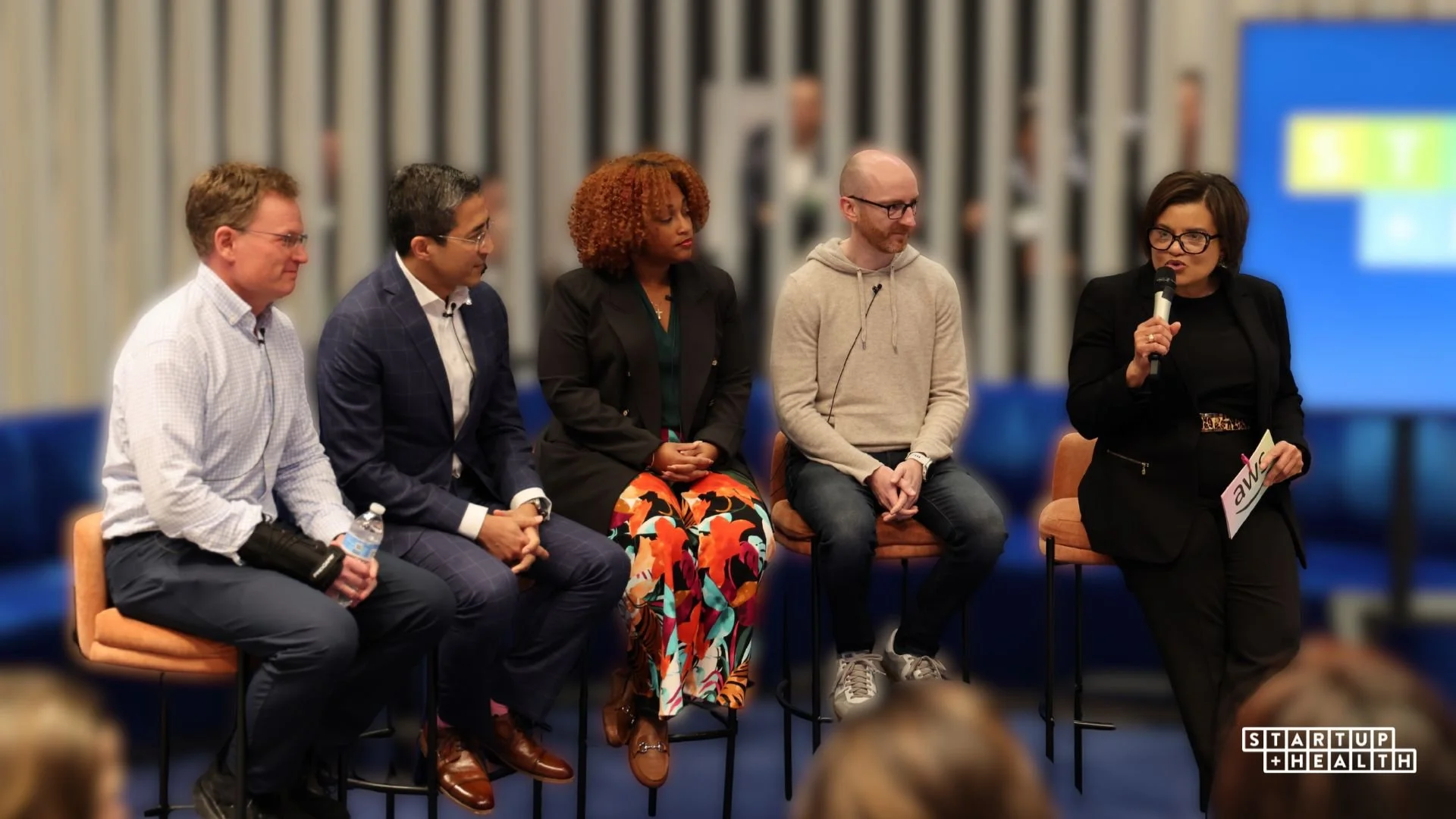
At Apollo House during JPM Healthcare Week, StartUp Health convened a cross-sector panel that captured the full complexity and promise of this moment in health innovation. Leaders spanning care delivery, diagnostics, cloud, and AI infrastructure came together to explore what it will take to achieve Health Moonshots in the Age of Superintelligence.
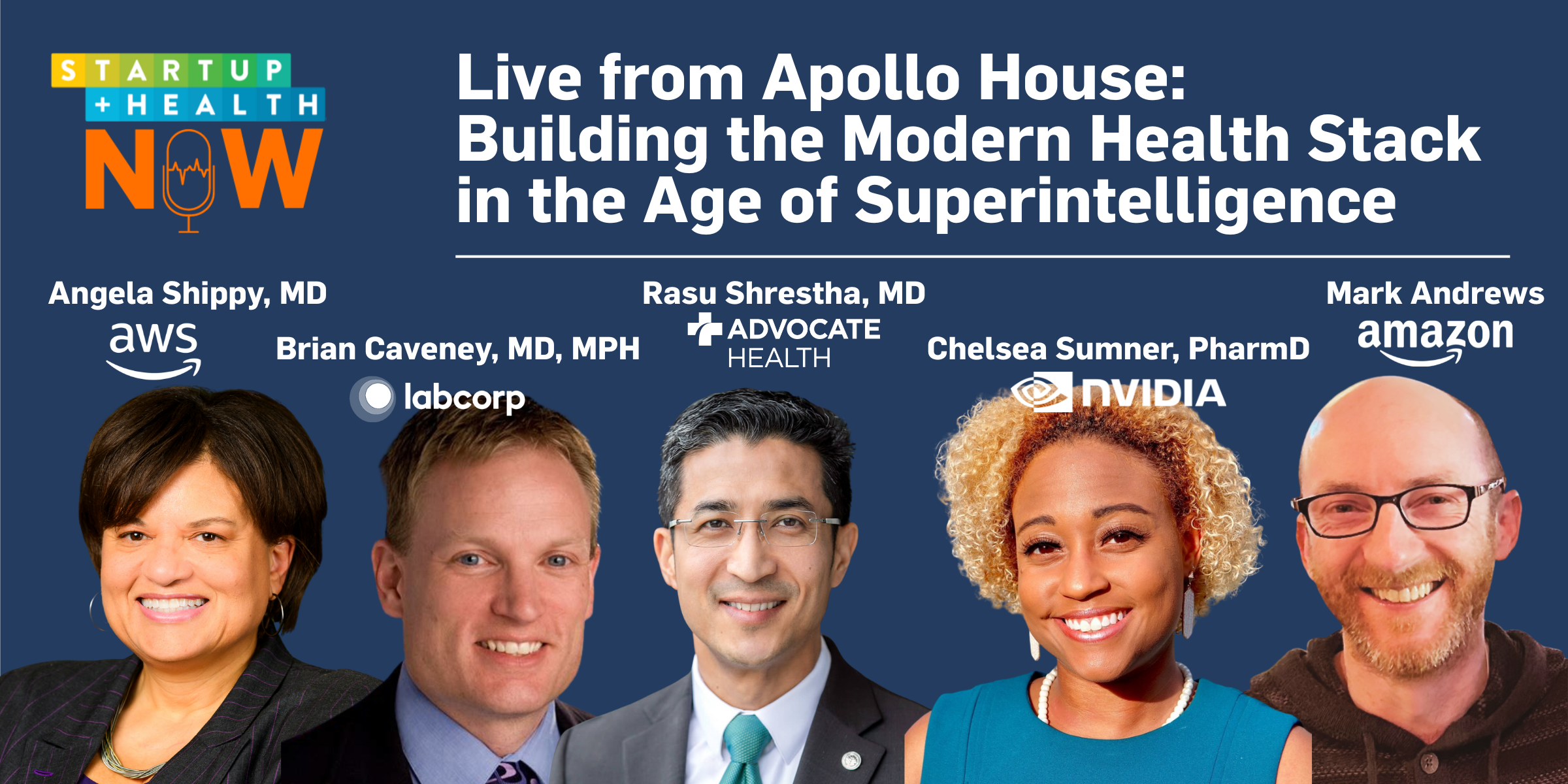
Moderated by Angela Shippy, MD, Senior Physician Executive and Clinical Innovation Lead for Global Healthcare and Nonprofit at Amazon Web Services, the conversation reflected a shared recognition that healthcare is changing faster than ever before. Drawing on her background as an internal medicine physician and health system executive, Dr. Shippy grounded the discussion in lived clinical experience, emphasizing that technology only matters if it improves how people give and receive care. As she noted, technology is ultimately “what’s going to make a difference in how we take care of people in the future.”
For Rasu Shrestha, MD, EVP and Chief Innovation and Commercialization Officer at Advocate Health, the opportunity ahead is less about chasing tools and more about rethinking the foundation of care itself. He argued that AI gives healthcare a chance to move beyond labels and transactions toward something more human. In his words, this is the moment to move “from patient-centered care to truly person-centered care,” recognizing that while people may be patients or members at different times, “all the time, we are people.” Dr. Shrestha also offered a clear warning about misusing technology, reminding the audience that “AI is not a silver bullet. If you digitize a broken process, you end up with a broken digital process.”
From the diagnostics perspective, Brian Caveney, MD, MPH, Chief Medical and Scientific Officer at Labcorp, focused on the critical role of data quality. He explained that AI can only be as effective as the information it is built on, pointing out that lab data stands apart because it is standardized, structured, and quantitative. That foundation, he noted, enables AI-driven decision support that can help clinicians choose the right tests, reduce misdiagnosis, and improve outcomes. As Dr. Caveney emphasized, AI may accelerate insight, but medicine remains “a healing art,” requiring a careful balance between science, technology, and human judgment.
Chelsea Sumner, PharmD, Translational Health and AI Strategy Leader at NVIDIA, reframed one of the most common fears surrounding AI in healthcare. Rather than replacing clinicians and scientists, she described AI as an extension of their capabilities. “You’re not losing your job,” she said. “You’re gaining an AI scientist in your pocket.” By enabling agentic workflows and open, accessible models, Dr. Sumner described how AI can reduce documentation burden, ease burnout, and allow clinicians and researchers to focus on discovery, problem-solving, and time with patients.
Representing the frontier of AI model development, Mark Andrews, Senior Principal and AGI Product Leader at Amazon, highlighted differentiation as the next defining challenge. He argued that real advantage will not come from generic models alone, but from combining foundational AI with domain-specific expertise and proprietary data. As Andrews put it, “If you want to differentiate your business, you need to differentiate the model your application is based on.” In healthcare, that specialization is essential for safety, trust, and meaningful impact.
Across the discussion, a consistent theme emerged. The technology is here. The infrastructure is advancing rapidly. What will determine success is intention, trust, and collaboration across startups, health systems, and technology leaders. The Apollo House panel made clear that health moonshots are no longer theoretical. They are becoming practical outcomes, shaped by leaders willing to build together, with purpose, in the age of superintelligence.
Watch on StartUp Health TV
Listen on StartUp Health NOW
Join StartUp Health
An exclusive global community for the bold decision makers, thought leaders, funders, and innovators transforming the future of health
Network Plans for Everyone in the Ecosystem: If you're a decision maker, thought leader, funder, or industry stakeholder – this is where the global health ecosystem comes together to learn from experts, share insights, build relationships, explore partnerships, and shape what’s next in health. Join today, no application necessary.
Health Moonshot Plans for Startups & Scaleups: If you're a founder or CEO building a digital health, biotech, or life sciences company, our Health Moonshot Communities are designed for collaboration, coaching, and strategic growth at every stage. Our communities include: Alzheimer’s & Brain Health, Cardiometabolic & T1D, Food as Medicine, Mental & Behavorial Health, and more. If you’re mission-driven, collaborative, and ready to contribute as much as you gain, you might be the perfect fit. Learn more and apply today.
Follow us on LinkedIn for daily updates on Health Moonshots.
Published: Jan 27, 2026
Produced by Nicole Kinsey